The Four-Question MSA Statement Audit You Can Run on Your Own Filing This Week
Australian Modern Slavery Act statements fail in a small number of repeating ways across thousands of filers, and those failures are detectable from the filed statement itself in roughly ninety minutes. Four questions to read what regulators see.
By Matthew Bilo
A 2022 assessment of Australian Modern Slavery Act statements by the Human Rights Law Centre, the Australian Human Rights Institute (UNSW), the RMIT Business and Human Rights Centre, the University of Melbourne, and the University of Notre Dame Australia found that 77% of evaluated statements failed to meet basic reporting requirements.[1] Average mandatory-criterion compliance across the assessed cohort was 59%.[1]
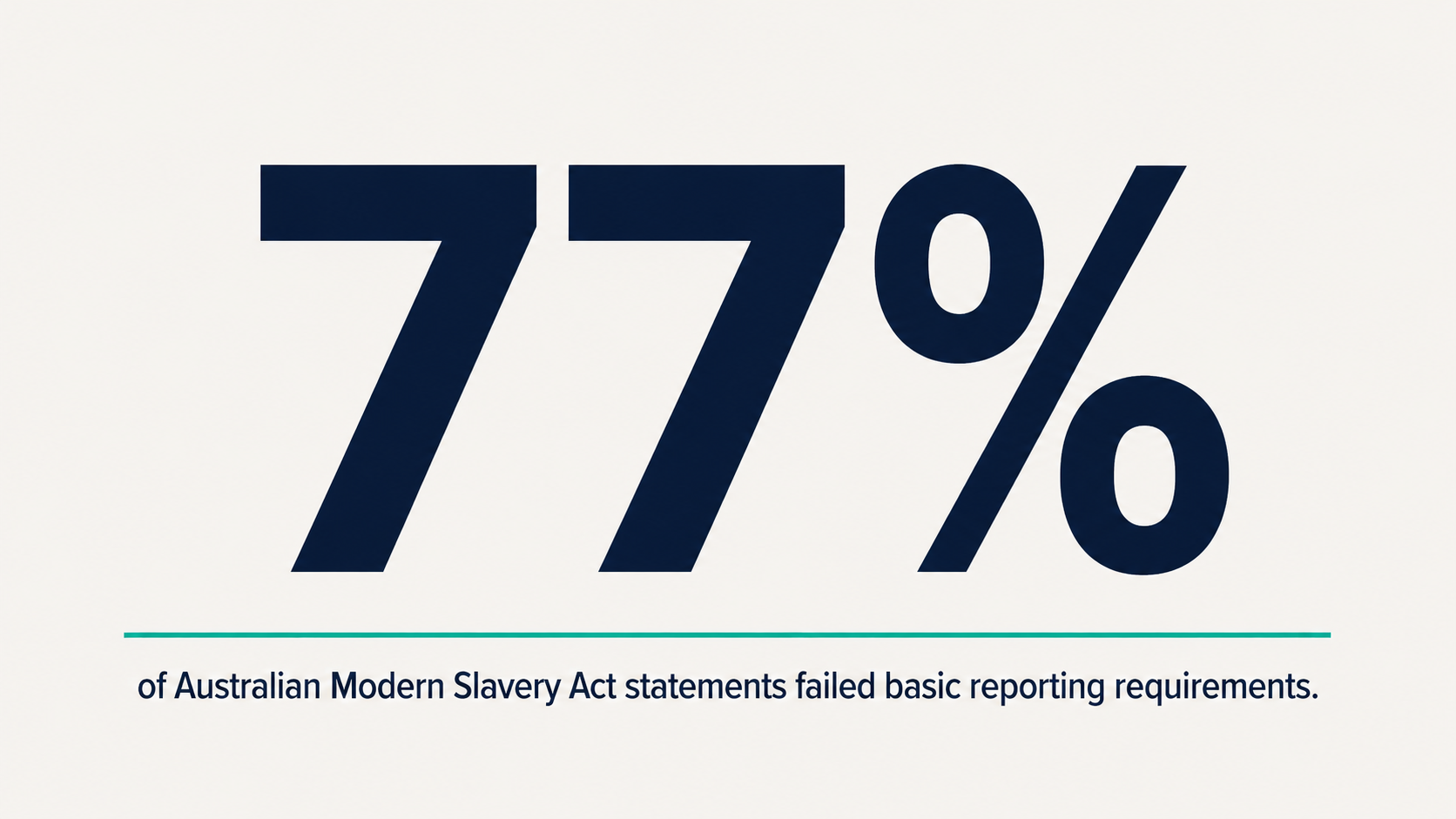
Source: Paper Promises (2022).
The obvious reading is that the compliance officers writing those statements are doing something wrong. They are not. The people writing AU MSA statements are usually procurement managers, general counsel, or sustainability leads pulling in a Big-4 advisor or a templated draft at the eleventh hour. The output is bad in a small number of repeating ways across thousands of filers, and those ways are detectable from the filed statement itself, by the buyer who owns it, in roughly ninety minutes.
This piece sets out the four questions to ask of your own most recent filing. The patterns the questions detect are documented in Paper Promises (2022),[1] Walk Free's Beyond Compliance Garment sector assessment of UK and Australian filers,[2] and the AIMS.au sentence-level annotation taxonomy released by Mila and QUT in 2025.[3]
The 59% average obscures real variance across the six mandatory criteria in section 16(1) of the Act. Reporting entity identification scores 100% across the cohort. Effectiveness assessment scores 53%. The four questions in this piece concentrate on the criteria where filers consistently fall short.
Source: Paper Promises (2022).
Hover or focus a bar to see the full criterion description.
Average mandatory-criterion quality score across the assessed cohort: 59%.
Why your existing tooling does not catch this
Walk Free publishes a free Modern Slavery Benchmarking Tool. KPMG Australia publishes a Modern Slavery Benchmark on its marketplace.[4] Both are comprehensive instruments and both are worth using. They are also program-side instruments. They score what your organisation self-reports about its modern slavery program through a structured questionnaire. They do not read the statement you filed.
The difference is not academic. The Australian Government's Modern Slavery register receives statements. The Anti-Slavery Commissioner reviews statements. The civil-penalty regime foreshadowed in the Federal Government's July 2025 Stream A consultation paper, with submissions closed on 1 September 2025, will sit on top of statements.[5] A buyer who scores well on a program survey can still file a bottom-quartile statement.
The four questions below read the artefact regulators receive. Use them alongside Walk Free's tool, not instead of it. The Walk Free tool is available at walkfree.org/resources/modern-slavery-benchmarking-tool.[6]
The four questions
Does your risk section name specific products, geographies, and supplier tiers, or does it stay at category level?
Failure pattern. Buzz-words at category level without naming the specific products, countries, or supplier tiers where the risk sits.
Good benchmark. Each named risk attaches to a specific product, a geography, and a supplier tier, with quantified exposure where possible.
Excerpt, Retail Trade, $200-250M: "areas within [the entity's] supply chain that have an increased modern slavery risks are: apparel (such as uniforms), electronics (such as computers and mobile telephones), coffee beans and produce from fruit farms. These goods are either located in, or sourced from, countries or regions that are estimated to have a higher prevalence for modern slavery..."
When your statement describes how you screen suppliers, does it document a process with criteria and frequency, or does it describe sending a questionnaire?
Failure pattern. A third-party tool or supplier questionnaire stands in for a documented due-diligence process.
Good benchmark. Named screening criteria, a stated cadence, an explicit escalation trigger, and an integration point into purchasing decisions.
Excerpt, Manufacturing, $300-350M: "[The entity] uses a third-party tool, the iPRO Modern Slavery Assessment Tool (MSAT) to assess modern slavery risks... We engaged iPRO during the reporting period to conduct a bulk assessment of 400 of our suppliers... Participating suppliers were asked to complete a self-assessment questionnaire online..."
When your statement describes remediation, does it describe a worker-facing mechanism with a real case or outcome, or does it assert capability?
Failure pattern. A generic corporate hotline framed as a worker-side mechanism, with zero reports treated as evidence the system works.
Good benchmark. A worker-facing channel with a named board owner, language access for the relevant supply-chain workforces, an anonymity guarantee, and at least one quantitative outcome across the reporting period.
Excerpt, Healthcare and pharmaceuticals, $150-200M: "To date, no complaints or concerns relating to modern slavery have been raised." That is the entire remediation disclosure.
When your statement describes how you assess effectiveness, does it name a metric, a target, or a year-on-year change?
Failure pattern. Process descriptions ("we continue to review", "we track our actions") substituted for measurement.
Good benchmark. A named quantitative indicator reported across at least two periods, with a baseline or comparison so trend is visible.
Excerpt, Retail Trade, $200-250M: "[The entity] endeavours to continually assess its effectiveness in identifying and managing modern slavery risks by tracking its actions and outcomes. The actions taken by [the entity] so far have: provided management with a greater insight of [the entity's] supply chain and operations..."
Question 1: Does your risk section name specific products, geographies, and supplier tiers, or does it stay at category level?
Paper Promises identified "the use of buzz words to create the illusion of compliance" across evaluated AU MSA statements, with "limited evidence of real understanding" in the risk-description sections specifically.[1] Walk Free's Garment sector assessment found that only 31% of Australian garment-industry statements met requirements for approval and mandatory criteria, with risk identification a recurring weak area.[2]
What to look for in your own statement. Scan the risk section for at least one named country, one named product or commodity, and one named supplier tier. Each named risk should attach to one or more of those.
What good looks like. Each risk identifies a specific product, service, or category; attaches it to a geography or jurisdiction; names the supplier tier where the risk sits; and quantifies exposure where possible (spend share, supplier count, sourcing volume).
Falling short. Food and beverages, agriculture and fishing. $100-150M.
"Risks across the supply chain include underpayment of wages and excessive working hours, exploitation of migrant workers and importing goods from countries with varying risk levels."
The risk factors are correct. There are no countries, no products, no tiers, and no quantified exposure.
Better practice. Ansell Limited (FY23). Healthcare and pharmaceuticals. $1B+.
"The sourcing of raw materials such as rubber, cotton, minerals and metals, in addition to finished goods and packaging products are from supply chains in which instances have been reported of child labour, forced labour and human trafficking. The market conditions prevalent in some sections of the PPE industry, particularly third party manufacturers producing high volume low cost commoditised products contribute to the high risk profile for human rights abuses in our supply chain."
Specific raw materials, specific harm types, and specific industry segments. The same statement also names country-level exposure: top direct-sourcing in Vietnam covers finished goods, industrial supplies, chemicals, yarn and textiles, and finished goods spend in Malaysia covers more than 19,000 migrant workers.
Question 2: When your statement describes how you screen suppliers, does it document a process with criteria and frequency, or does it describe sending a questionnaire?
Paper Promises is direct on this point: "supplier questionnaires and audits... can be wholly inadequate in detecting human rights issues. Social audits do not equate with human rights due diligence."[1] On the AU cohort specifically, the report found a 60% compliance rate against mandatory criterion 4 (actions taken to assess and address risk, including due diligence and remediation), with companies more frequently disclosing due diligence on supplier operations (84%) than on their own operations (64%).[1]
What to look for in your own statement. The due-diligence section should describe four things at minimum. The criteria a supplier is screened against. The frequency of screening. What triggers escalation. How findings flow into purchasing decisions.
What good looks like. A documented process with named criteria (sector, geography, spend threshold), a stated cadence, an explicit escalation trigger, and an integration point into procurement.
Falling short. Healthcare and pharmaceuticals. $150-200M.
"...the risk area for [the entity] is the ability to identify suppliers, who cause, contribute to, or are directly linked to, modern slavery. To address this, [the entity] will continue to develop its modern slavery risk framework and exposure to modern slavery through improved risk assessment and due diligence with suppliers."
The due-diligence section is a future-tense aspiration. It is not a current process.
Better practice. Coles Group (FY24). Food and beverages, agriculture and fishing. $1B+.
"Invested over $865,000 to fund ethical audits of sites in Australia that are in scope of our Ethical Sourcing Program. This brings our total audit investment to over $3.79 million in the past three years, supporting farms in Australia and building the capabilities of Australian certification bodies... Monitored or supported suppliers to close 1,289 critical and 4,228 major non-conformances from audits conducted under our Ethical Sourcing Program, an overall increase of 4.8% year on year."
Named program (Ethical Sourcing Program) as the integration point, named scope (in-scope sites in Australia), named investment ($865,000 this year, $3.79M over three years), action volumes (1,289 critical and 4,228 major non-conformances closed), and a year-on-year delta.
Question 3: When your statement describes remediation, does it describe a worker-facing mechanism with a real case or outcome, or does it assert capability?
Paper Promises identifies remediation as "one of the weakest areas" of AU MSA reporting. Companies "tend to mistake the term 'remediation' to relate solely to correcting non-compliances by suppliers, rather than ensuring remedy for affected workers." 16% of surveyed companies committed to providing remedy if they cause or contribute to modern slavery. 4% committed to compensation.[1]
What to look for in your own statement. The remediation or grievance section should name a worker-facing channel with language access and anonymity, name who governs it, and disclose either an aggregate outcome (complaints received, complaints actioned) or an anonymised case.
What good looks like. A worker-side mechanism with a named board owner, language access for the workforces relevant to the supply chain, an anonymity guarantee, and at least one quantitative outcome across the reporting period.
Falling short. Financial services. $350-400M.
"There were no reports of [the entity's] employees or suppliers using the [third-party whistleblower service] during the reporting period with grievances associated with modern slavery."
Paper Promises names the obvious problem with this framing: "the fact that several companies state no risks had been identified through their grievance mechanism may be an indication of problems with the effectiveness of the grievance mechanism rather than a sign that there is no exploitation."[1]
Better practice. Coles Group (FY24). Food and beverages, agriculture and fishing. $1B+.
"We have a grievance management framework which includes accessible and confidential grievance mechanisms partnered with appropriate remediation procedures... Investigated 17 complaints raised through external facing grievance mechanisms."
A named framework, accessible worker-facing channels, and a quantitative outcome (seventeen complaints actioned during the reporting period).
Question 4: When your statement describes how you assess effectiveness, does it name a metric, a target, or a year-on-year change?
Paper Promises groups effectiveness with remediation as "particularly poorly handled" against mandatory criterion 5.[1]
What to look for in your own statement. At least one quantitative indicator, with a baseline or a comparison across reporting periods.
What good looks like. A named metric (audits completed, training completion rate, grievances actioned, supplier turnover after risk findings), reported across at least two periods so the trend is visible.
Falling short. Food and beverages, agriculture and fishing. $100-150M.
"We assess the effectiveness of our assessments on the number of reported incidents. We have not received any reports of modern slavery breaches within our supply chain during the reporting period."
Effectiveness is explicitly defined as the absence of reports.
Better practice. Beyond Bank Australia (FY23). Financial services. $350-400M.
"We achieved an uplift of over 20% in the response to our Supplier Self-Assessment Survey, taking our response rate from last year of 32% to 53%... Our SAQ process involved 55 suppliers, making up 81% of our year-to-date spend."
A named metric, a baseline, a year-on-year change, and a stated scope.
What to do with the answers
If your filed statement passes all four questions, your statement sits in the top band of AU filers. Use the audit as confirmation that your last engagement was money well spent.
If one or two questions return red flags, the gap is targeted. Most failures of this kind can be closed in the next filing cycle by tightening the relevant section, with no platform change and no vendor change required.
If three or four questions return red flags, your filed statement sits in the band that Paper Promises measured. The internal conversation worth having is not how to fix this draft. It is why the firm you paid is producing the same boilerplate as bottom-quartile filers across the register.
Scope and limits
This audit reads the filed statement only. It does not assess your underlying modern slavery program. It does not validate supplier-side data quality. It does not review board governance of your modern slavery program. Walk Free's Modern Slavery Benchmarking Tool covers program self-assessment.[6] An internal audit covers data quality. A separate governance review covers the board view.
Sector-specific failure patterns also exist for filers in financial services, retail and apparel, agribusiness and food, manufacturing, and healthcare. The four questions above are sector-agnostic by design and do not address them.
Better-practice examples in this piece are named with attribution, consistent with the convention used by Paper Promises (2022) and Walk Free's Beyond Compliance series. Falling-short examples are anonymised by sector and revenue band, to focus the reader on the pattern rather than on the individual filer.
Six mandatory criteria in section 16(1) of the Modern Slavery Act 2018, the corresponding AIMS.au sentence-level labels (Bora et al., 2025), and the four questions in this audit. The audit deliberately concentrates on criteria (c), (d), and (e), where Paper Promises (2022) finds the cohort consistently falls short.
AIMS.au includes Approval and Signature as separate document-level labels alongside the six section 16(1) criteria, for eleven labels in total.
Run it on your own filing
The four questions in checklist form. Copy and paste into your notes app, or print the section.
If you would like a more thorough read of your own filed statement against the AIMS.au taxonomy and the patterns above, get in touch.
Sources
- Human Rights Law Centre, Australian Human Rights Institute (UNSW), RMIT Business and Human Rights Centre, University of Melbourne, and University of Notre Dame Australia. Paper Promises? Evaluating the Early Impact of Australia's Modern Slavery Act. February 2022. humanrights.unsw.edu.au
- Walk Free. Beyond Compliance in the Garment Industry. Assessing UK and Australian Modern Slavery Act statements. 2022.
- Bora, A. E., St-Charles, P., Bronzi, M., Fansi Tchango, A., Rousseau, B., and Mengersen, K. AIMS.au: A Dataset for the Analysis of Modern Slavery Countermeasures in Corporate Statements. arXiv 2502.07022, 2025; Mila and QUT. arxiv.org/abs/2502.07022
- KPMG Australia. Modern Slavery Benchmark. marketplace.kpmg.com.au/modernslaverybenchmark
- Attorney-General's Department. Strengthening the Modern Slavery Act: Consultation Paper. 21 July 2025; submissions closed 1 September 2025. Available via the AGD website.
- Walk Free. Modern Slavery Benchmarking Tool. walkfree.org/resources/modern-slavery-benchmarking-tool