Australian Modern Slavery Due Diligence Almost Never Tests for ABN Misclassification. The 2026 Evidence Says That Is Where The Risk Sits.
The largest empirical study of migrant work in Australia since COVID names a specific gap: lead firms running modern slavery due diligence rarely if ever look for sham contracting or workers engaged on an ABN. The numbers say that gap covers the single largest unmeasured exploitation channel in the country, and four observable signals can close it without a new vendor.
By Matthew Bilo
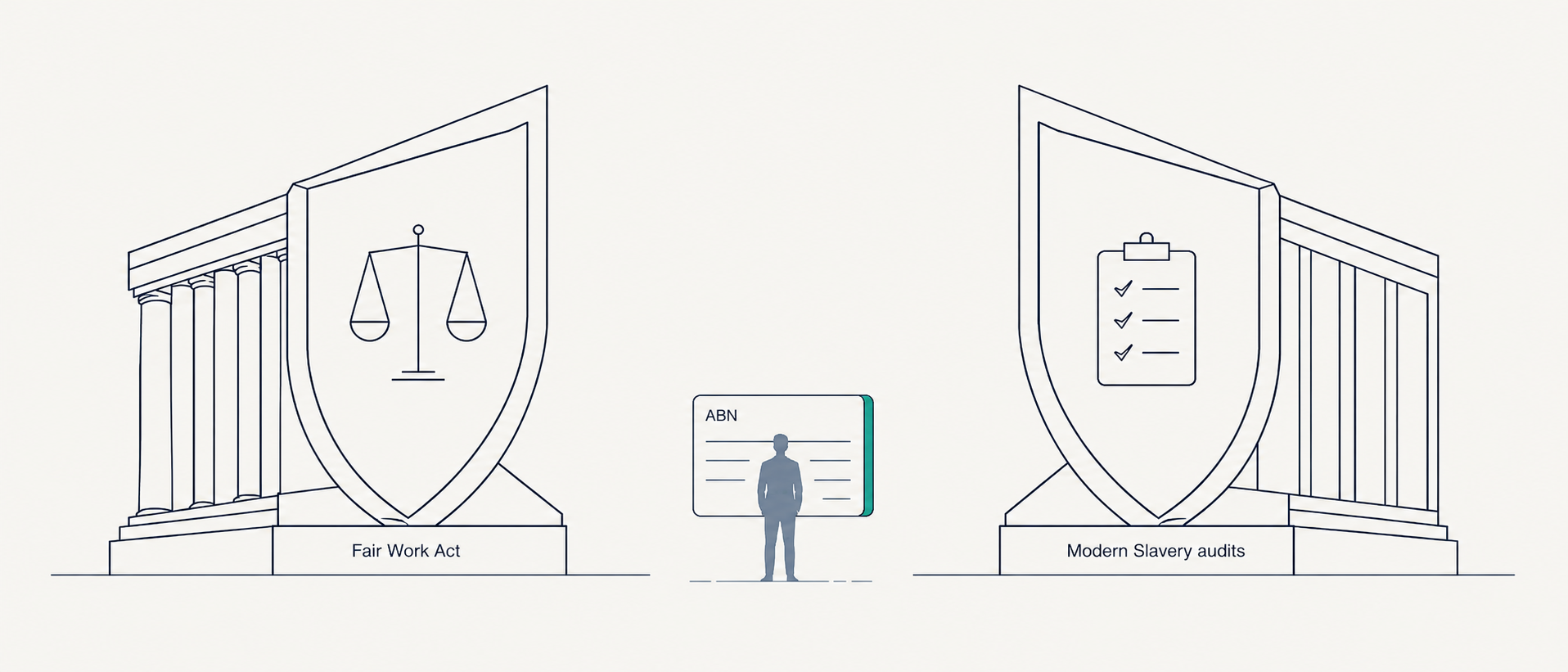
The structural gap. Misclassified ABN workers sit between Fair Work jurisdiction and modern slavery audit coverage.
The Migrant Justice Institute's Off the Books report, released in May 2026 and based on 9,963 responses from temporary visa holders across Australia, contains a sentence that should reset how Australian reporting entities scope their modern slavery due diligence.[1]
When lead firms conduct risk assessments or due diligence for modern slavery or other noncompliance within their operations or supply chain they rarely if ever look for misclassification or sham contracting (or engagement of independent contractors at all).
That is page 62 of the report, and it is the most direct critique of current Australian modern slavery practice in any primary research published this decade.
The single most common structural mechanism by which migrants in Australia are systemically underpaid, sham contracting via an Australian Business Number (ABN), is also the mechanism that almost no Australian modern slavery program is configured to detect. To put a number on it, we scanned every available statement filed in the 2024, 2025, and 2026 reporting cycles in the Attorney-General's Modern Slavery Statements Register (N = 8,359). "Misclassification" appeared in 5 statements (0.1%). "Sham contracting" appeared in 62 (0.7%). "ABN" used in the context of worker engagement (engaged on an ABN, ABN workers, ABN-based contracting) appeared in 0. The buyers most exposed to this gap are also the buyers least likely to know it exists, because the gap is invisible from the artefacts they currently audit.[2]
This article sets out the evidence, the structural reason your existing due diligence does not catch it, and four observable signals that can be added to a supplier scoring model in the next reporting cycle.
Percentage of statements containing at least one mention of each term. Sample N = 8359. Source: Bilo Labs corpus scan, 2024 to 2026 reporting cycles.
Labour hire and migrant worker sit in the statement vocabulary; ABN engagement and misclassification do not. That is the gap.
What the 2026 evidence says
Off the Books is the third national survey of its kind run by the Migrant Justice Institute, following the 2016 Wage Theft in Australia and the 2020 International Students and Wage Theft reports.[1] Fieldwork was conducted between July and August 2024 across every state and territory, in six languages.
Four findings on insecure work and misclassification are load-bearing for any reporting entity.
35% of migrants in their lowest paid job in 2023 to 2024 were engaged on an ABN. That is more than four times the prevalence of independent contracting in the general Australian workforce. The majority of those on ABNs (61%) were in industries where genuine independent contracting is uncommon, which is the standard structural marker of sham contracting.[1]
85% of all ABN workers in the survey were paid less than they would have been entitled to as a casual employee under the Fair Work Act.[1] Engagement on an ABN is, in this cohort, among the strongest predictors of below-entitlement pay.
One in five surveyed participants (21%) worked on an ABN in an industry where independent contracting is not common, and 41% of those workers were paid below the floor of the National Minimum Wage.[1] Recommendation 1 of the report calls this finding out specifically, and recommends reducing the evidentiary threshold for a sham contracting claim.
Misclassified ABN workers fall outside the Fair Work Ombudsman's jurisdiction unless and until they can prove they are misclassified. Most cannot. The report describes case after case in which workers had no written contract. Workers in the report describe being told by accountants or by the employer that ABN engagement is normal practice. The structural effect is that the workers least protected by Australian labour law are also the workers least likely to ever be counted in a regulator's exploitation statistics.[1]
These findings are incredibly concerning. The Migrant Justice Institute estimates that international students alone are short-changed approximately $3.18 billion per year on the basis of the survey data, and ABN engagement is a primary vehicle.[1]
Why your existing due diligence does not see this
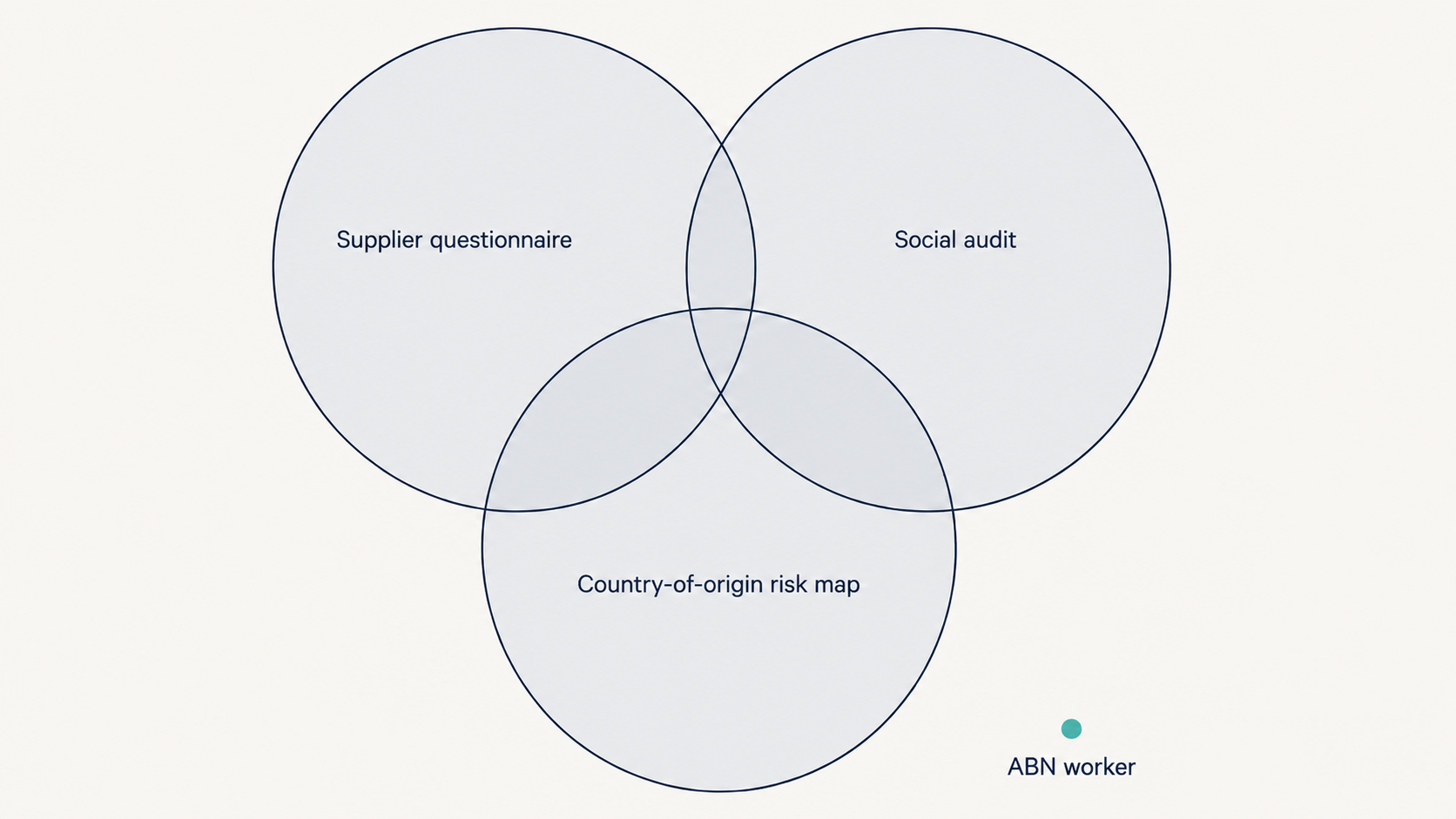
Three standard audit instruments. One worker outside all three.
There is a specific structural reason that modern slavery due diligence in Australia is configured around supplier questionnaires, social audits, and country-of-origin risk maps, and almost never around the contracting structure under which workers inside Australia are engaged.
Three reasons, in order of how much each contributes to the blind spot.
First, the artefacts you audit do not contain the data. A Tier 1 supplier completing a self-assessment questionnaire is asked about its workforce policies, not about how many of the workers on its premises are engaged on ABNs through a labour-hire intermediary or through a series of subcontractors.
Second, the variable is invisible to social audit. A standard SMETA-style or similar third-party audit interviews workers and inspects records on the day of the audit. ABN-based engagement looks like normal independent contracting on the day. Standard third-party audit instruments evolved to detect failure modes in direct factory employment, not contractor misclassification. It does not pick up the failure mode that Off the Books documents in 2026, which is structural reclassification of would-be employees as contractors to escape the Fair Work Act.
Third, the typology guiding most modern slavery programs treats forced labour as a binary event upstream. Misclassification seems like a tax-and-workplace-relations problem until you read the report's finding that forced labour indicators rise smoothly with the depth of underpayment, and that the deepest underpayment in the survey is concentrated among workers on an ABN.[1] The report's framing, that forced labour sits on a continuum with administrative noncompliance, is empirically grounded. In the 8,359-statement scan, 4.1% mentioned a continuum or spectrum framing of exploitation. The vocabulary of administrative noncompliance is present but uneven: 9.1% mentioned underpayment in some form, 1.9% mentioned wage theft or underpaid wages, and 6.7% referenced the Fair Work Act. The contracting structure that Off the Books identifies as the dominant vehicle for that noncompliance is essentially absent.[2]
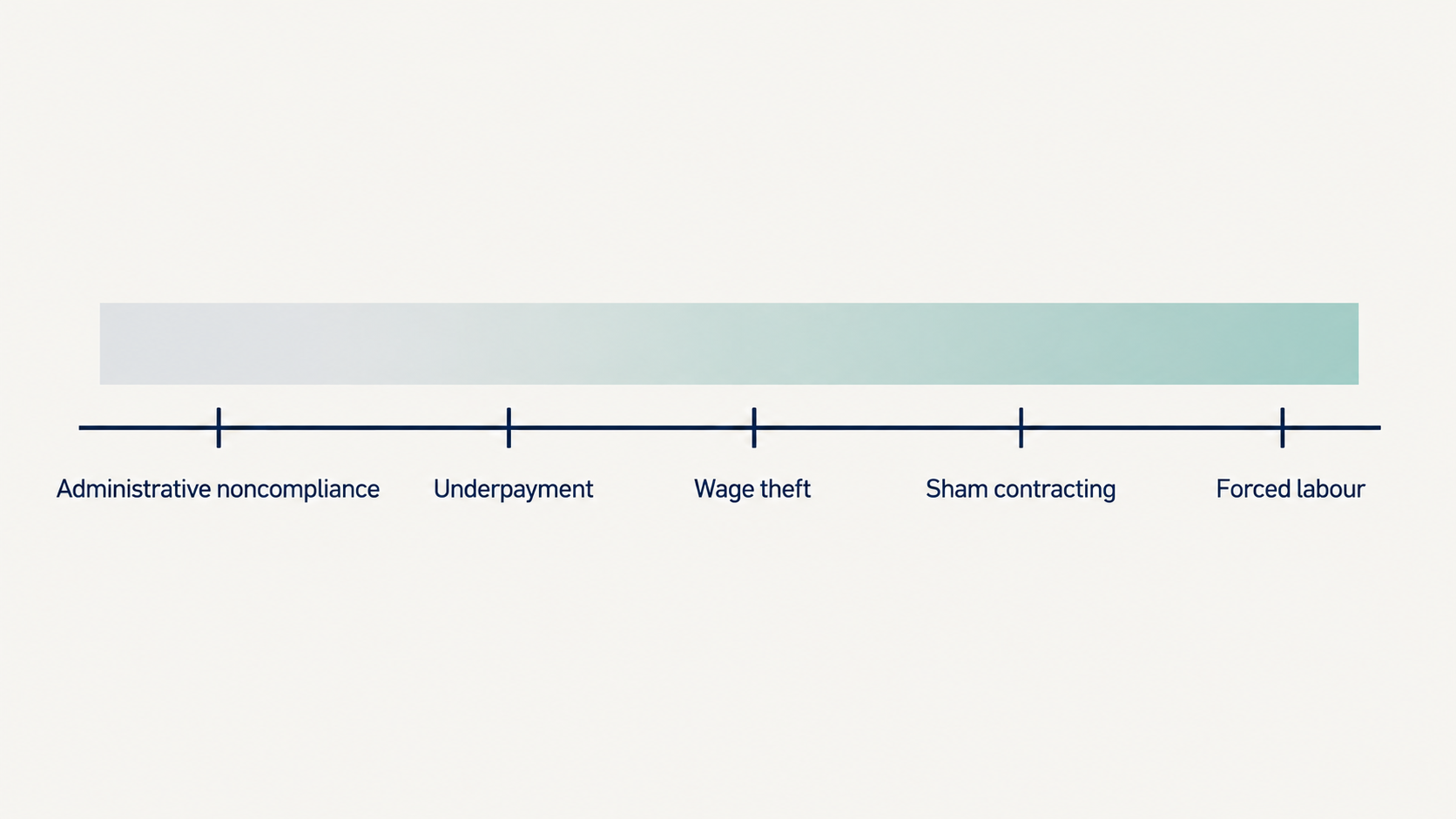
Off the Books frames forced labour as the far end of a continuum, not a binary event. Misclassification sits on the same line.
The combined effect is that a buyer can run a fully compliant modern slavery program, file a top-quartile statement, and still have no information about the variable that, in 2024 survey data, separated 85% of one cohort from their Fair Work Act minimum.
What the leaders actually say
The phrase "sham contracting" appears in 62 of 8,359 statements (0.7%). It is concentrated in construction and transportation-and-logistics supplier categories, and where it appears, it is typically framed as a risk in suppliers' operations, not the reporting entity's own. The 2023 statement of the Port Authority of New South Wales is a representative example of that framing.
Representative framing. Port Authority of NSW (FY23). Transportation, logistics, and storage. $200-250M.
"A risk that there is sham contracting within the operations of Port Authority's suppliers, and subsequent underpayment of fair wages to sub-contracted labour."
In the small minority of statements that name sham contracting (0.7% of 8,359), the risk is typically located in suppliers, not in the reporting entity's own operations.[2]
Most mentions of "wage theft," 1.9% of statements, are grievance-line boilerplate: a worker-help phone number, typically "To report possible wage theft, contact the Fair Work Ombudsman on 13 13 94." Statements from ISPT and the Westpac and BT reporting entities use this exact format. Almost none of the 8,359 statements analytically treat underpayment as an in-Australia operational risk to their own workforce or their labour-hire intake.
Falling short, boilerplate pattern. ISPT and Westpac/BT (FY23). Financial, insurance and real estate activities.
"To report possible wage theft or related workplace issues, contact the Fair Work Ombudsman on 13 13 94..."
A worker-help phone number is not an in-Australia operational risk assessment. Identical phrasing appears in multiple statements across financial services filers.[2]
There are two exceptions in the sample worth quoting at length.
Better practice, buyer side. Westpac Banking Corporation and BT reporting entities (FY23). Financial, insurance and real estate activities. $1B+.
Responsible Sourcing Questionnaire asks "targeted questions on employment practices including how they manage outsourcing, employment of temporary visa holders, workers under the age of 18, and use of recruitment agencies and subcontractors. Where suppliers are providing labour hire under our Talent Acquisition Managed Service Provider (MSP) agreement, workers are paid in accordance with the Banking and Finance award..."
The closest any statement in our sample comes to the Off the Books Recommendation 10 specification on the buyer side. It still contains zero references to ABN engagement.[2]
Better practice, operations side. Hellers Australia (FY25). Food and beverages; manufacturing. $100-150M.
"Labour hire remains one of our most significant modern slavery risks... we transitioned away from relying on labour hire at our Jandakot and Bendigo sites... we increased our directly engaged staff in Jandakot from 94% to 99%. In Bendigo we increased our directly engaged staff from a low of 67% to 81%... we require labour hire providers to demonstrate transparent wage payments and deduction disclosures, appropriate wages according to the applicable award rates."
A named in-Australia operations risk, a year-on-year tenure-profile metric, and a payment-transparency control on the labour-hire intake. In substance, two of the four signals proposed later in this article. Hellers does not use the word ABN or the word misclassification.[2]
What "Off the Books" is asking lead firms to do
The report is direct in its industry-facing recommendations. Recommendation 9 calls for an enforceable, risk-based due diligence obligation under the Modern Slavery Act 2018 (Cth).[1] This direction has been signalled before by the Australian Anti-Slavery Commissioner, and an enforceable risk-based due diligence obligation falls within Stream B of the federal government's Modern Slavery Act review reform agenda, to be addressed through targeted consultation following the July 2025 Stream A paper.
Recommendation 10 is the one most reporting entities should read carefully. Quoted in full:
Industry should voluntarily play a greater role in detecting underpayment and other noncompliance in their Australian operations and supply chains, starting with routine auditing of payslips and scrutiny of visa holders engaged on ABNs and as casuals.
That recommendation is also a specification. It names the artefact (payslips), the cohort (visa holders on ABNs and as casuals), and the action (routine auditing and scrutiny). A reporting entity that adds these to its next due diligence cycle is acting on the most current empirical evidence in the country.
Pick a sector to see how often each term appears in its filed statements, against the full-cohort baseline.
Financial, insurance and real estate activities
N = 873 statements in our sample
Cohort baseline is the same 8359-statement sample described in the Scope and limits section.
Four observable signals to add to your supplier scoring model
The good news for reporting entities is that detecting misclassification risk in your supplier base does not require a new platform, a new vendor, or new worker interviews. The variables that flag risk are observable from data your procurement function already touches, or that any compliant supplier should be able to provide on request.
The four signals below correspond to the structural risk indicators identified across Parts 4 to 7 of Off the Books. None of them appears at the operational specificity Off the Books calls for in more than 1% of the 8,359 statements filed in the 2024, 2025, and 2026 cycles. Payslip auditing, the artefact-specific control given in Recommendation 10, appears in 0.5% of statements (40 of 8,359).[2] This is the empirical baseline against which a reporting entity acting on these signals would be measured.
Signal 1: Industry-adjusted ABN share at the supplier site
The benchmark variable. Off the Books establishes that ABN engagement above the rate prevalent in a given industry is, by itself, a sham-contracting indicator.[1]
What to ask your supplier. Of the workers performing the contracted services at the site or sites engaged with your business, what proportion are engaged on an ABN, and what proportion are engaged as casuals, permanent employees, or fixed-term employees?
What good looks like. A documented breakdown that allows comparison to the industry baseline. Hospitality, commercial cleaning, retail, horticulture, nail salons, and delivery and rideshare work all carry above-average ABN exposure in the report, including 87% of delivery riders and 88% of rideshare and taxi drivers on an ABN. A supplier in any of these industries with an ABN share materially above the in-industry mean has an exposure your due diligence has not yet priced.
Pick an industry to see the ABS baseline rate of independent contractor engagement, the rate Off the Books observed among migrant workers, and the threshold logic that applies to a supplier in that industry.
All Australian workers (whole-economy floor)
ABS baseline
7.5%
Working Arrangements, August 2024
Migrant cohort (Off the Books)
35%
ABN share among migrant workers in this role
ABS records 7.5% of the Australian workforce on an ABN. Off the Books records 35% of migrants on an ABN, more than four times the rate. Any in-industry comparison below should start from this gap.
ABS rates from Characteristics of Employment, Working Arrangements, August 2024. Migrant cohort figures from Berg and Farbenblum, Off the Books, May 2026.
Falling short. Typical supplier non-answer.
"Workers are engaged in accordance with applicable laws."
That is a non-answer.
Signal 2: Payslip integrity
Provision of payslips improved from 56% in 2016 to 84% in 2024.[1] Over the same period, however, 8% of migrant employees received a payslip that omitted hours, and a further 40% received payslips that recorded all hours but reflected underpaid wages. The control that audits whether a payslip exists no longer detects exploitation.
What to ask your supplier. A sample of payslips, not aggregated payroll reports, with all of the elements required under the Fair Work Regulations 2009, including hours, hourly rate, and itemised loadings.
What good looks like. Payslips that itemise after-hours work at penalty rates, that show casual loading where applicable, and where the implied hourly rate matches or exceeds the relevant award. The report establishes that absence of these line items, or the line items being present but reflecting below-NMW pay, is a near-universal predictor of underpayment.[1]
Falling short. Artefact your supplier substitutes in.
Payroll summaries by cost centre, in which individual hourly rates are aggregated away.
The artefact looks complete and obscures the variable that matters. Per-worker hourly rate is the test; aggregated payroll cannot meet it.
Signal 3: Cash component and superannuation status
23% of survey respondents received at least some of their wages in cash, and the absence of a payslip or the absence of superannuation each independently predict a roughly 67% to 70% probability of below-NMW pay.[1]
What to ask your supplier. Documentation that all wages at the site are paid by electronic transfer, and that superannuation is paid for all eligible workers including those engaged through any subcontract.
What good looks like. Bank-trace evidence and superannuation contribution evidence that names the workers and matches the period of work. For ABN workers, evidence of voluntary superannuation contribution does not satisfy the test, because most ABN workers should be receiving it as employees and are not.
Falling short. Typical supplier non-answer.
"We pay our workers in accordance with their preferred method."
Cash preference, in this cohort, is overwhelmingly the employer's preference, not the worker's.
Signal 4: Tenure profile and the new-arrivals premium
The risk of underpayment was greatest for those who had arrived in Australia within six months of the survey, with 46% paid below NMW and 81% paid below the casual minimum.[1] Length-of-stay risk attenuates over time but does not disappear: at three years and beyond, 28% remain below NMW.
What to ask your supplier. The tenure distribution of workers performing contracted services at the relevant sites. Specifically, what share have less than 12 months in Australia.
What good looks like. A tenure profile that does not disproportionately concentrate exploitation-window workers in your in-scope service. A supplier whose business model relies on a churn of new arrivals is statistically a high-risk supplier even if its policy documentation is in order.
Falling short. Typical supplier non-answer.
"We do not collect this information."
That answer, in 2026, is itself a finding.
What to put in your next statement
A reporting entity that wants to act on Off the Books in its next reporting cycle does not need to rebuild its program. Three additions to the existing structure are sufficient.
In your risk identification. Name ABN misclassification as an in-Australia operations risk, alongside the country-of-origin and supply-tier risks already identified. Note specifically the industries within your supplier base that exhibit above-average ABN exposure.
In your due diligence description. Document that, for the in-scope categories, you collect data on the four signals above, and describe the threshold or trigger that escalates a supplier for further review. This satisfies the Off the Books Recommendation 10 specification of "routine auditing of payslips and scrutiny of visa holders engaged on ABNs and as casuals."
In your effectiveness section. Report the proportion of in-scope suppliers for which you have collected the four signals, and the proportion for which the data were complete. A baseline this year is a year-on-year delta next year. Quantitative year-on-year metrics in effectiveness sections remain rare in current Australian statements.
A statement that adds these three elements is, on the strength of the 2026 evidence, ahead of the field. It is also closer to the standard of practice that an enforceable risk-based due diligence obligation, if and when introduced, is most likely to require.
Scope and limits
This article reads two sources. The structural argument and the four signals derive from the Migrant Justice Institute's 2026 Off the Books report and its primary survey data of 9,963 temporary visa holders. The figures on what Australian modern slavery statements currently say derive from the full available set of statements filed for the 2024, 2025, and 2026 reporting cycles in the Attorney-General's Modern Slavery Statements Register (N = 8,359), text-extracted and keyword-scanned in May 2026.[2] The author is not affiliated with the Migrant Justice Institute, and the Institute is not endorsing the framing or recommendations in this article.
The corpus scan uses regex keyword matching, not semantic classification. A statement that addresses misclassification in different vocabulary would not be counted. Approximately 11% of statement PDFs in the register (924 of 8,359) are image-only scans that returned near-zero extracted text under PyMuPDF; these are treated as null observations for keyword detection. True hit rates may be slightly higher than reported.
The signals are designed to be operationalised inside an existing Australian modern slavery program. They are not a substitute for worker-side grievance mechanisms, for direct engagement with worker representatives, or for the broader supplier audit instruments your program already uses. They are designed to close a specific structural gap that the existing instruments do not.
A forthcoming Practical Guidance from the Migrant Justice Institute is referenced at page 18 and page 20 of the report. When it is released, it will supersede the operational specifics in this article. The structural gap it addresses, however, is unlikely to change.
Sources
- Berg, L. and Farbenblum, B. Off the Books: Inside Australia's Hidden System of Migrant Worker Exploitation. Migrant Justice Institute, May 2026. Findings cited from Executive Summary, Part 4 (Employment Structure), Part 6 (Impact of Temporary Migrant Status), Part 7 (Noncompliance Beyond Underpayment), Part 8 (Other Factors), Part 10 (Forced Labour and Underpayment), and Part 12 (Recommendations). Available at migrantjustice.org.
- Bilo Labs corpus scan, May 2026. Full available set of 8,359 modern slavery statements filed for the 2024, 2025, and 2026 reporting cycles, drawn from the Attorney-General's Modern Slavery Statements Register. Statements were text-extracted with PyMuPDF and scanned for a fixed pack of regular expressions covering misclassification, sham contracting, ABN engagement, labour hire, payslip auditing, Fair Work Act references, wage theft, underpayment, visa-holder workforce, cash wages, superannuation, and continuum-of-exploitation framing. Approximately 11% of PDFs (924 of 8,359) returned near-zero extracted text, indicating image-only scans, and are treated as null observations. Full per-statement results are retained on file.